A Word to the Wives (1955)

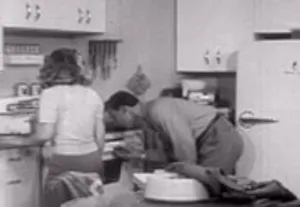
Housewife Jane covets her friend Alice's modern ranch-house kitchen and quietly campaigns for one of her own; while Jane visits her mother, her husband George's slapstick struggles in their outdated kitchen finally convince him to buy the family a new house built around the kitchen Jane wanted.
Directed by Norman Lloyd and sponsored jointly by the American Gas Association, the National Association of Home Builders, and Woman’s Home Companion, A Word to the Wives is as much a showcase for Caloric, Whirlpool, and Formica products as it is a comedy, capturing 1950s suburban consumerism at its most unabashed; RiffTrax later gave it the comedic treatment, and a sample of its dialogue turned up in Justin Timberlake’s 2013 single “Don’t Hold the Wall.”
Background
A Word to the Wives was directed by Norman Lloyd, written by Jerome Brondfield, and produced by Edmund M. Tate as a sponsored film jointly backed by the American Gas Association, the National Association of Home Builders, and Woman’s Home Companion. Marsha Hunt plays Jane, who envies her friend Alice’s modern ranch-house kitchen and, prompted by Alice, sets out to maneuver her husband George, played by Darren McGavin, into buying one of their own. The film doubles as a showroom for its sponsors’ products, naming Caloric, Whirlpool, Formica, Republic Steel Kitchens, and Ruud by brand while Jane is conveniently away visiting her mother.
What to watch for
George’s slapstick struggles with their outdated kitchen, a stuck drawer, a dim light, inadequate counter space, do the real persuading in the plot, turning ordinary domestic annoyance into the engine that gets him to buy the house Jane wanted all along. The film is a clean example of 1950s sponsored filmmaking, where brand names sit openly inside a sitcom-style plot instead of being confined to a separate commercial, and Darren McGavin’s early, unglamorous role is worth noting for viewers who know him only from later work. RiffTrax later gave the short its comedic treatment, finding ready material in its unblinking product placement.