D.O.A. (1949)
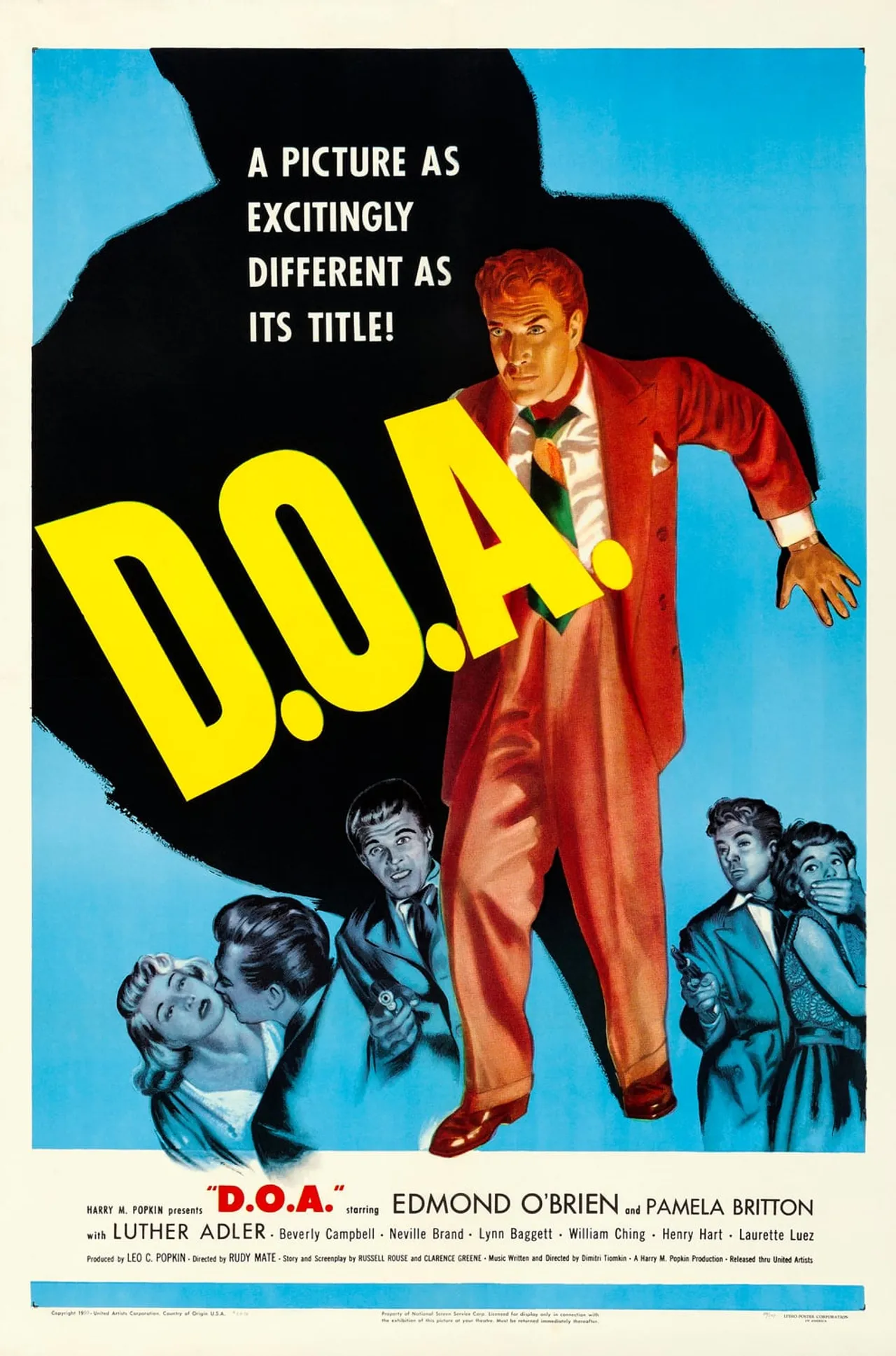
A small-town accountant walks into a police station to report a murder — his own. Slipped a "luminous toxin" with no antidote, he has a day or two to trace the poison back through nightclubs, blackmail and a shipment of stolen iridium before it kills him. Told entirely in flashback from a dead man walking.
The purest ticking-clock premise in noir: the detective and the corpse are the same man, and the clock never stops.
Background
Rudolph Maté was a distinguished cinematographer before he directed, with credits reaching back to Carl Dreyer’s silent work, and D.O.A. has the look of a man who knows exactly where to put the camera. Clarence Greene and Russell Rouse wrote the screenplay. The opening is one of the most famous in noir: Frank Bigelow walks into police headquarters and announces that he wants to report a murder, his own.
What to watch for
After that setup the film rarely lets up. Location shooting in San Francisco and Los Angeles gives it a documentary-like urgency, and the climax runs through the Bradbury Building in downtown Los Angeles, whose glass-roofed atrium and iron staircases have appeared in many films since. Edmond O’Brien plays Bigelow as an ordinary man whose panic grows steadily. The film was remade with Dennis Quaid in 1988, but the original’s bleakness, and its fatalism about how quickly a normal life can be poisoned, is hard to match.