Blacksmith Scene (1893)
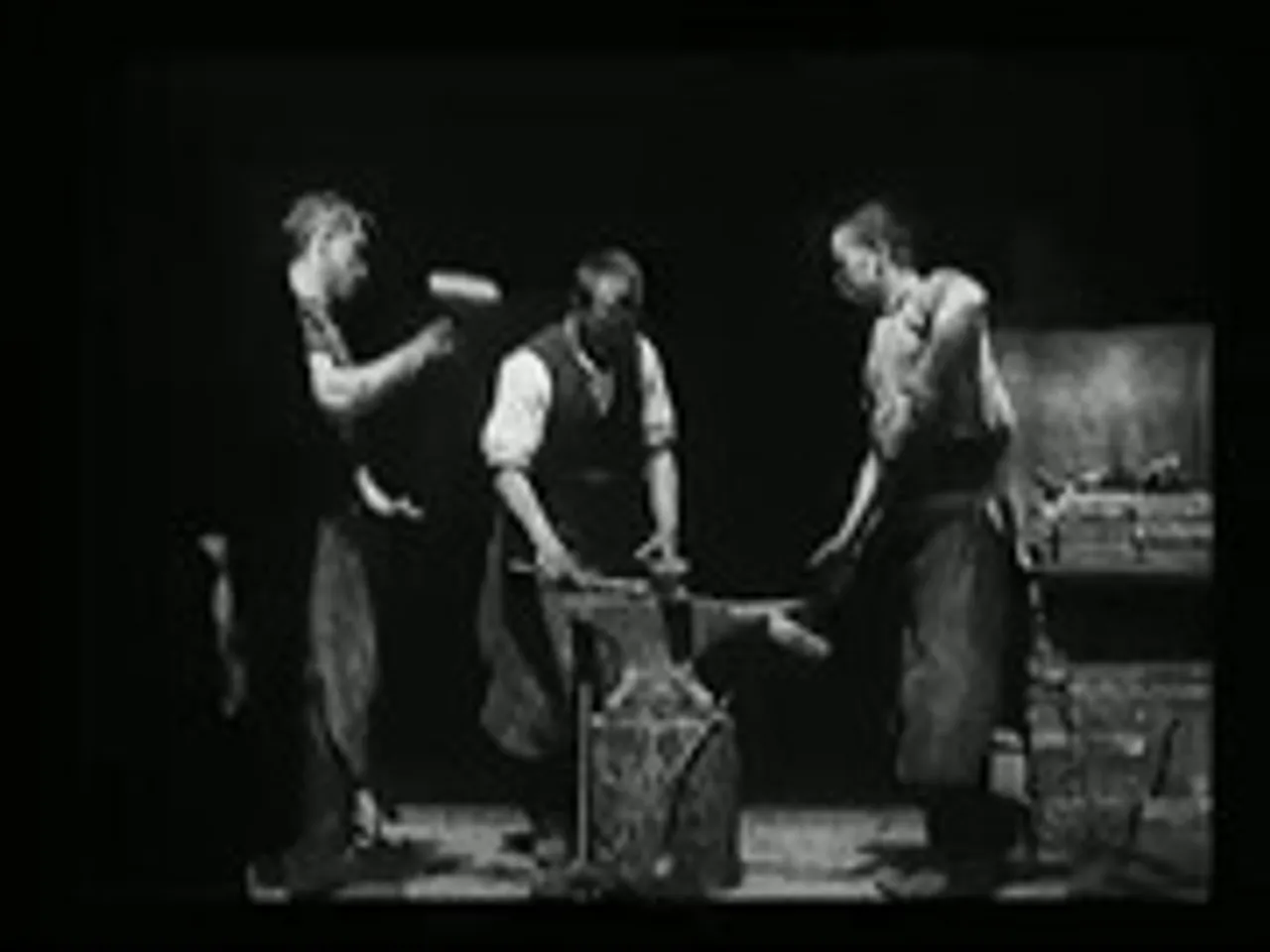
Three men at an anvil act out the work of a blacksmith shop, taking turns hammering a piece of hot iron, then pausing to pass around a bottle of beer before returning to the forge.
Made at Edison’s Black Maria studio in New Jersey, Blacksmith Scene was the first motion picture demonstrated to a gathered public audience and is among the earliest surviving American films. It is preserved in the National Film Registry.
Background
Filmed at Edison’s Black Maria studio in West Orange, New Jersey, probably in April 1893, Blacksmith Scene was directed by William Kennedy Dickson and runs barely thirty-four seconds. It was shown to a paying public audience in a Kinetoscope peephole viewer at the Brooklyn Institute of Arts and Sciences on May 9, 1893, making it among the first motion pictures ever exhibited to a general audience rather than a private demonstration. The Library of Congress added it to the National Film Registry in 1995, where it ranks as the second-oldest film in the Registry after Newark Athlete (1891).
What to watch for
Three men gather around an anvil, take turns hammering a glowing piece of iron, then stop to pass around a bottle of beer before going back to work. The men were Edison employees rather than actual blacksmiths, which makes the film, despite its documentary appearance, an early instance of screen acting: a staged scene performed for the camera rather than a record of real labor. Watching it alongside Edison’s other 1893 Kinetoscope subjects shows how quickly the studio moved from recording simple movement toward staging small comic or dramatic beats, like the beer break here, within those few seconds of film.