Till the Clouds Roll By (1946)
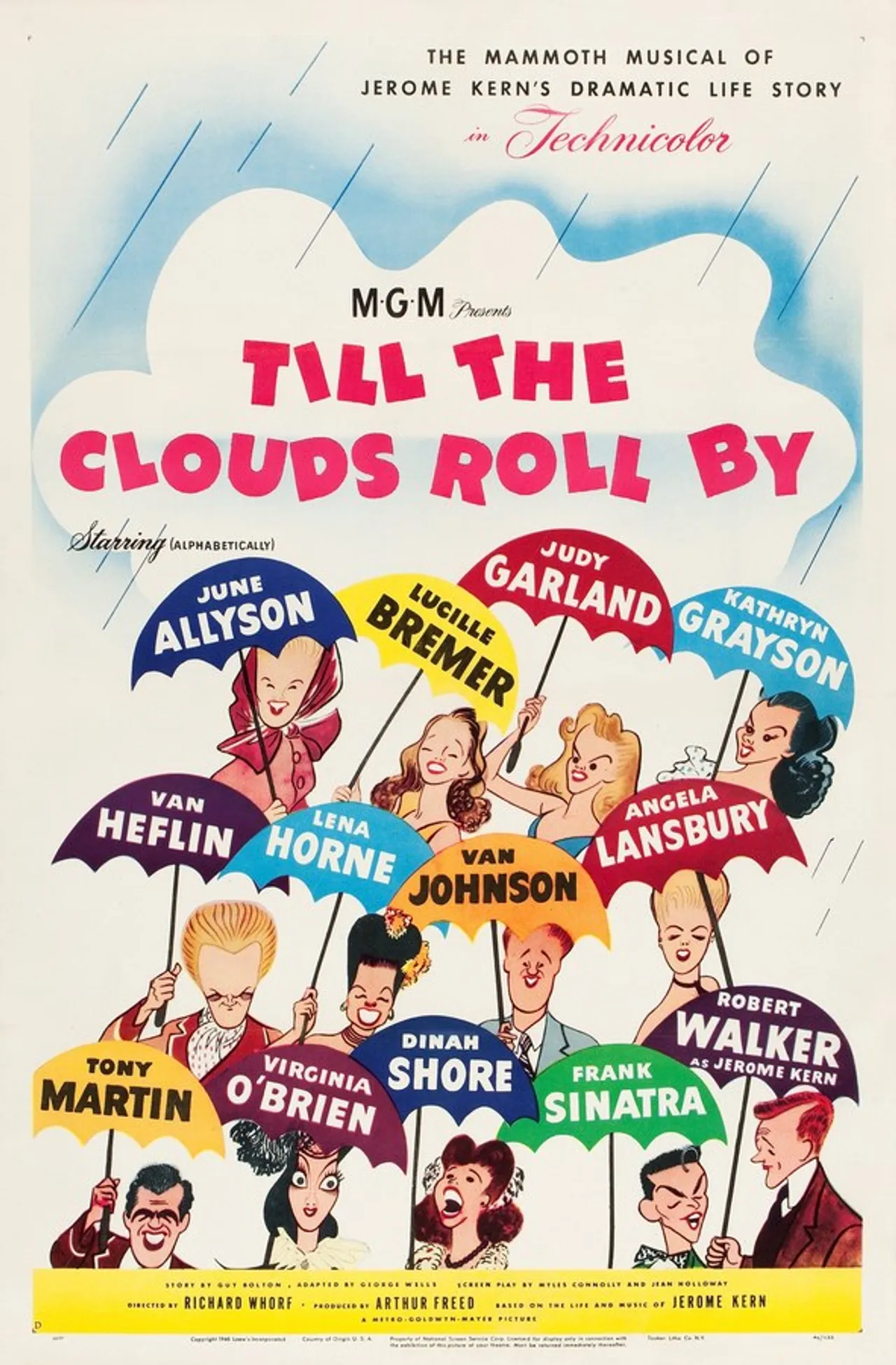
A heavily fictionalized account of the life of Broadway composer Jerome Kern, following him from early song-plugging and a first hit through the landmark 1927 premiere of Show Boat and on to Hollywood. The thin biographical thread is mostly a frame for two dozen Kern standards staged by MGM's roster of singing stars.
One of the lavish MGM musicals that slipped into the public domain when the studio missed its copyright renewal, Till the Clouds Roll By works less as biography — Jerome Kern died during production, and the story bears little resemblance to his life — than as a Technicolor revue, opening with a condensed Show Boat and running through numbers by Judy Garland, Lena Horne, and a young Frank Sinatra.
Background
Till the Clouds Roll By is a 1946 MGM musical directed by Richard Whorf. It is a loosely fictionalized account of the life of Broadway composer Jerome Kern, and the story bears little resemblance to his actual life. Kern died in November 1945, while the film was in production, and it was made as a Technicolor revue of his songs performed by the studio’s roster of stars. Judy Garland, Lena Horne and Frank Sinatra are among the performers. The film opens with a condensed version of Show Boat, Kern’s landmark 1927 musical. It runs about 132 minutes and was made during a period when MGM’s musicals were among its most lavish productions.
What to watch for
Look for the opening sequence, which stages a condensed Show Boat number, and for the way the film moves from one song to another with different MGM performers. The biographical thread is loose, and the film works mainly as a revue with a light frame around it. Judy Garland’s numbers and Sinatra’s appearance make the musical’s star power clear, and the Technicolor staging shows the studio’s production resources. Viewers interested in the Broadway tradition will find the staging useful, while those expecting an accurate life story should look elsewhere. Notice how the film uses the songs themselves to carry the emotional arc, rather than the biographical events.